
Intelligence (AI) has rapidly become one of the most transformative forces in technology. From automating workflows to enhancing customer experiences, AI is now embedded in nearly every business process. Yet, while organizations embrace AI for efficiency and innovation, the same technology is quietly dismantling traditional cybersecurity stacks. Legacy defenses that once protected email, networks, and applications are struggling against AI‑powered threats and uncontrolled AI adoption inside enterprises.
The rise of “shadow AI” — employees using unapproved AI tools without oversight — has created blind spots that weaken visibility and compliance. Attackers are also leveraging AI to craft sophisticated phishing campaigns, generate deepfake content, and automate malware creation. In this environment, businesses need more than point solutions; they require a unified, intelligent platform that can adapt to the AI era. This is where BarracudaONE steps in, offering complete cyber resilience with integrated intelligence, governance, and ecosystem support.
How AI Is Breaking Security Stacks
AI is not just a tool for innovation; it is also a weapon in the hands of cybercriminals. Traditional security stacks were designed to handle predictable threats, but AI introduces unpredictability and scale.
One of the most pressing challenges is shadow AI. Employees often experiment with AI tools for productivity, but many of these tools bypass IT approval. Without governance, sensitive data can be uploaded to external AI systems, creating risks of data leakage and compliance violations. A recent SecureEdge dashboard screenshot illustrates this problem: over 664 shadow AI tools were detected, with 129 classified as high‑risk. This volume of unmanaged tools is impossible to control with manual oversight.
Another issue is fragmented defenses. Legacy stacks rely on separate solutions for email filtering, endpoint protection, and network firewalls. These tools rarely communicate with each other, leaving gaps that attackers exploit. AI‑powered phishing campaigns, for example, can bypass email filters by mimicking human writing styles. Similarly, AI‑generated malware can adapt faster than signature‑based antivirus systems.
Finally, there are visibility gaps. Security teams cannot track thousands of AI tools in use across departments. Without centralized dashboards, organizations remain blind to risks. The SecureEdge analytics show how quickly this problem escalates: blocked AI tools increased by 350% in just 30 days, while unreviewed AI tools surged by 79%.
In short, AI is breaking security stacks by overwhelming defenses, bypassing oversight, and creating blind spots that legacy systems cannot handle.
Why Traditional Security Stacks Fail
Traditional security stacks were built for a different era — one where threats were slower, more predictable, and largely human‑driven. In the AI era, these stacks fail for several reasons:
First, point solutions don’t scale. A firewall may block suspicious traffic, and an endpoint tool may detect malware, but neither can handle the complexity of AI‑driven attacks. When hundreds of AI tools are introduced into the enterprise, point solutions cannot provide unified visibility.
Second, manual triage is too slow. Security teams often rely on human analysts to review alerts and approve tools. But with thousands of AI requests daily, manual processes collapse under the volume. Attackers exploit this delay, launching rapid campaigns that overwhelm defenses.
Third, compliance frameworks demand unified visibility. Regulations like GDPR, HIPAA, and PCI require organizations to demonstrate control over data flows. Shadow AI tools make compliance nearly impossible, as sensitive data may be processed outside approved systems.
The SecureEdge risk dashboard highlights this failure: 1,201 unapproved AI tools were detected, far exceeding the number of approved tools. Traditional stacks cannot provide the oversight required to meet compliance standards.
Ultimately, legacy defenses are reactive, fragmented, and compliance‑blind. They were never designed to handle the speed and scale of AI.
Staying Safe in the AI Era
The good news is that organizations can stay safe — but it requires a shift in mindset and technology.
The first step is governance. Businesses must define clear policies for AI usage, specifying which tools are allowed, which are blocked, and how data can be shared. Governance ensures that employees understand the risks and responsibilities of using AI.
The second step is visibility. Organizations need dashboards that monitor AI requests, users, and risk scores. For example, the SecureEdge inventory screenshot shows the AI tool “Adot” with a risk score of 10.5/25. This score reflects vulnerabilities and limited assurance, helping security teams decide whether to allow or block the tool. Visibility transforms AI usage from a blind spot into a managed process.
The third step is automated triage. Instead of relying on manual approval, platforms must automatically block unreviewed or high‑risk AI tools. SecureEdge provides buttons like “Block unreviewed” and “Block high risk AI,” enabling instant action. Automation ensures that threats are contained before they escalate.
Finally, education is essential. Employees must be trained on safe AI usage, including the risks of uploading sensitive data and the importance of using approved tools. Awareness reduces the likelihood of shadow AI adoption.
By combining governance, visibility, automation, and education, organizations can build resilience against AI‑driven threats.
BarracudaONE: The Complete Cybersecurity Platform
While governance and education are critical, technology must provide the backbone of AI‑era security. BarracudaONE delivers this backbone by integrating resilience, intelligence, foundation, and ecosystem support into a single platform.
The Resilience layer protects email, data, networks, and applications, while offering Managed XDR for extended detection and response. This ensures that every entry point — from inboxes to cloud workloads — is secured against AI‑powered attacks.
The Intelligence layer includes Bailey and BarracudaIQ, which provide AI‑driven insights into threats. These tools analyze patterns, detect anomalies, and deliver proactive recommendations, ensuring that defenses evolve as fast as attackers.
The Foundation layer offers Threat Radar, Trust Center, and success programs for partners and customers. This foundation ensures that organizations not only deploy technology but also receive ongoing support and assurance.
You can download BarracudaONE directly from Barracuda Networks’ official site as a free 30‑day trial. This is the safest and recommended way to access the platform.
https://www.barracuda.com/
How to Download BarracudaONE
- Go to the official Barracuda Networks download page (https://www.barracuda.com/).
- Select the product trial you want (BarracudaONE includes modules like Email Protection, Managed XDR, Endpoint Security, Cloud‑to‑Cloud Backup, etc.).
- Register with your business email to activate the free trial.
- Download the virtual product installer (available for cloud and on‑premises environments).
- Deploy on your server or cloud platform (Microsoft 365, AWS, Google Cloud integrations supported).
BarracudaONE in Action: A Visual Walkthrough
01. AI Security Overview
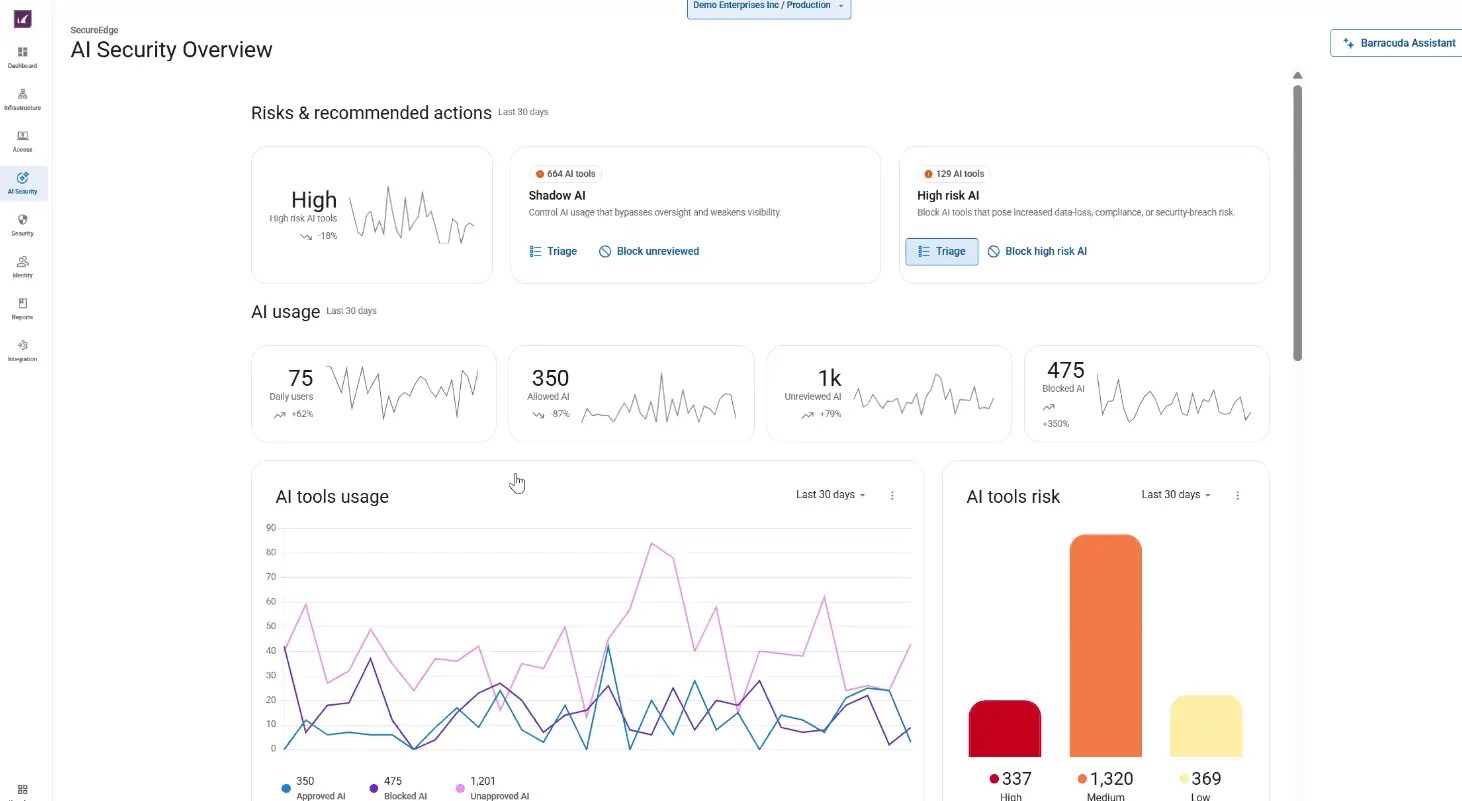
The AI Security Overview dashboard provides a high‑level snapshot of risks and recommended actions. In the screenshot you shared, the system detected 664 shadow AI tools — these are unapproved applications employees are using without IT oversight. Shadow AI weakens visibility and increases the chance of compliance violations.
Additionally, 129 high‑risk AI tools were flagged. These tools pose significant risks such as data leakage, unauthorized integrations, or vulnerabilities that attackers can exploit. The dashboard offers immediate actions like “Block unreviewed AI instantly”, ensuring that IT teams can contain risks before they escalate.
This visualization highlights how BarracudaONE, through SecureEdge, transforms risk management from a manual, reactive process into an automated, proactive defense.
AI Tools Inventory
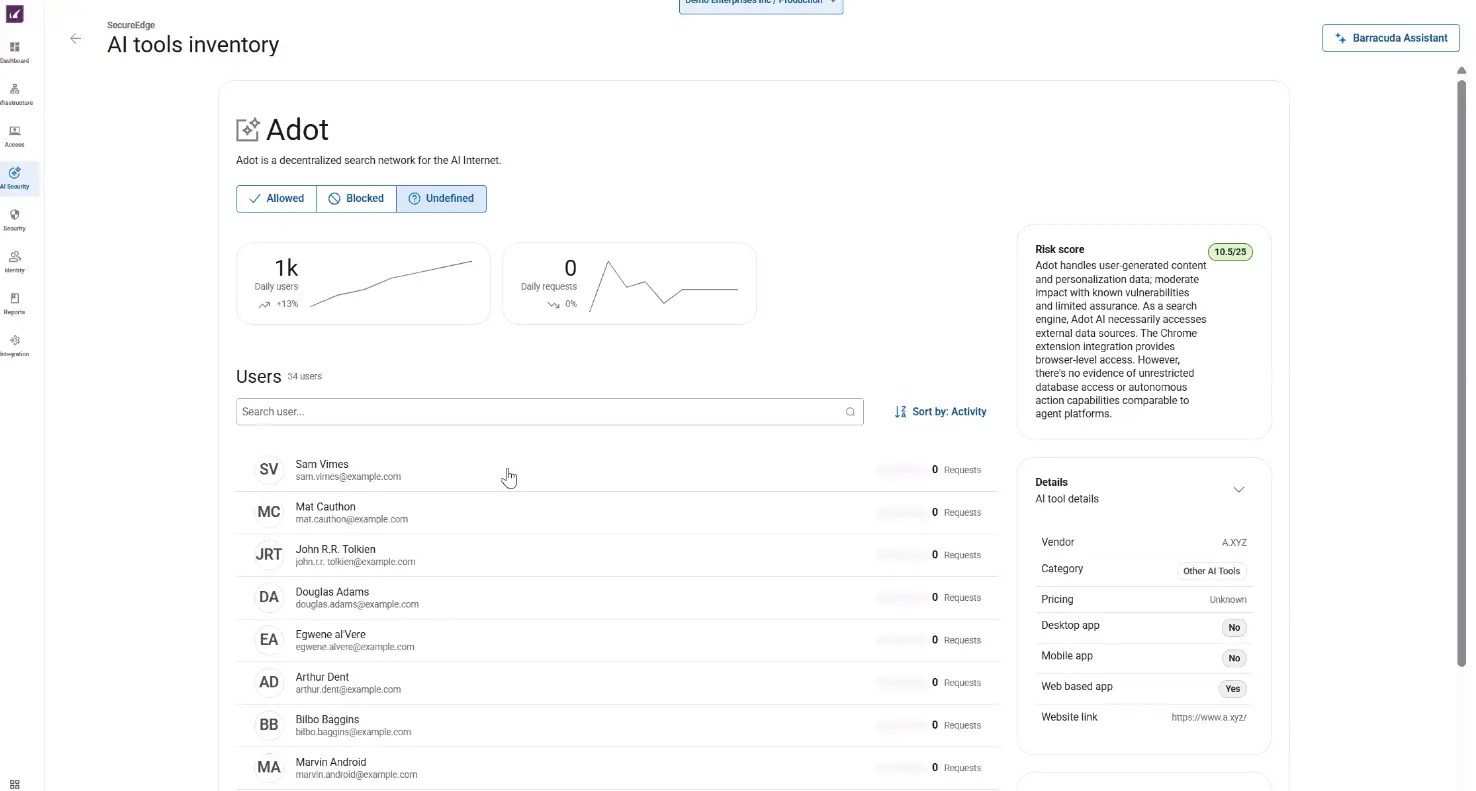
The AI Tools Inventory screenshot dives deeper into individual AI applications. Each tool is assigned a risk score based on vulnerabilities, assurance levels, and integration types. For example, the tool Adot received a risk score of 10.5/25, indicating moderate risk with known vulnerabilities.
The inventory also provides vendor details, integration methods (such as browser extensions), and whether the tool has desktop or mobile apps. Importantly, it tracks user activity — in your screenshot, several users like Sam Vimes and Douglas Adams had “0 requests,” showing no active engagement.
This granular visibility allows organizations to make informed decisions: whether to allow, block, or monitor a tool. It’s a critical step in AI governance, ensuring that every AI application is evaluated against security standards.
BarracudaONE Architecture
The BarracudaONE architecture diagram illustrates the platform’s layered approach.
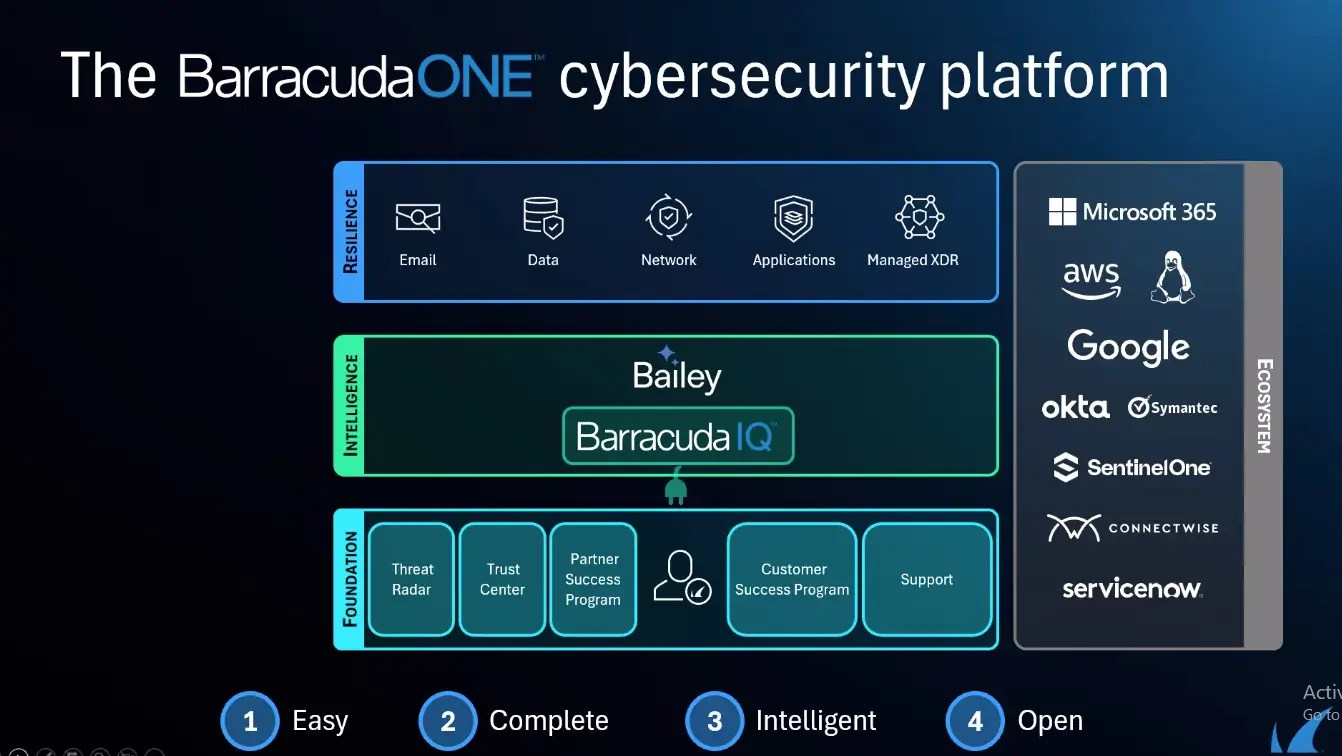
- Resilience: Protects email, data, networks, and applications, with Managed XDR for extended detection and response.
- Intelligence: Powered by Bailey and BarracudaIQ, delivering AI‑driven insights and anomaly detection.
- Foundation: Includes Threat Radar, Trust Center, and success programs for partners and customers.
- Ecosystem: Seamlessly integrates with Microsoft 365, AWS, Google, Okta, SentinelOne, ServiceNow, and more.
This architecture ensures that BarracudaONE is not just a collection of tools, but a complete cybersecurity platform. It unifies resilience, intelligence, and ecosystem support to address the challenges posed by AI.
From Click to Containment
The “From Click to Containment” screenshot demonstrates how BarracudaONE responds to threats across multiple layers.
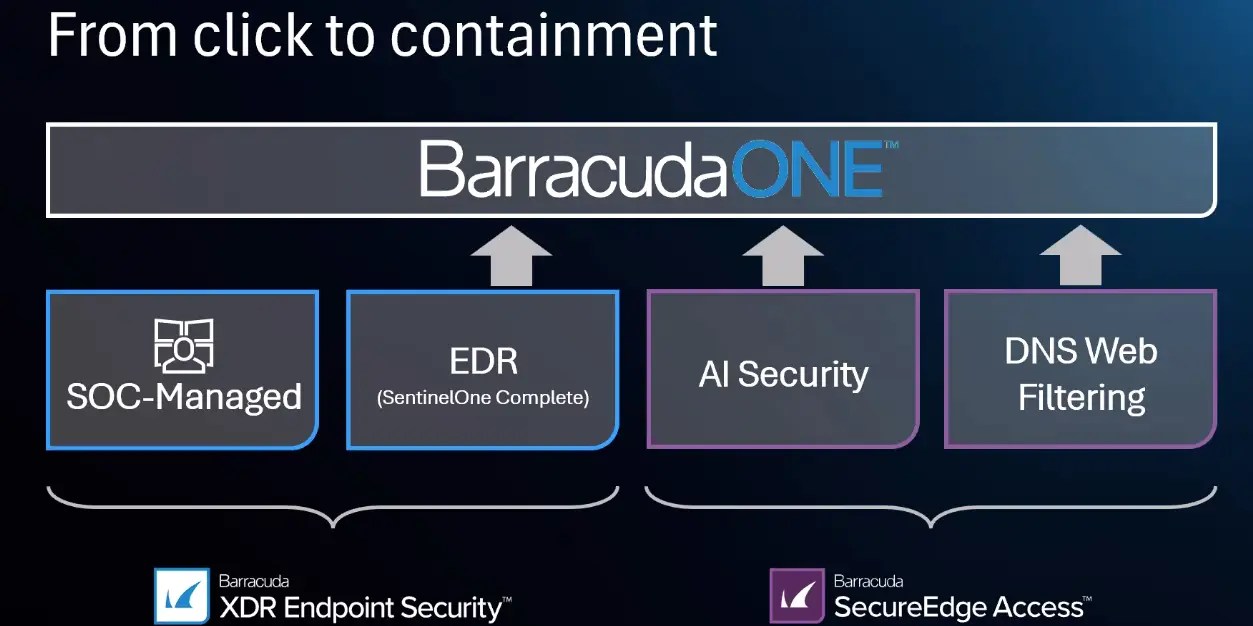
- SOC‑Managed monitoring ensures that every endpoint and network activity is continuously observed.
- SentinelOne EDR provides advanced endpoint detection and response, capable of handling AI‑powered malware.
- AI Security leverages machine learning to detect anomalies and suspicious patterns.
- DNS Web Filtering blocks malicious domains, preventing users from accessing harmful sites.
Together, these components form a seamless defense chain. From the moment a user clicks on a suspicious link to the point of containment, BarracudaONE ensures that threats are neutralized quickly and effectively.
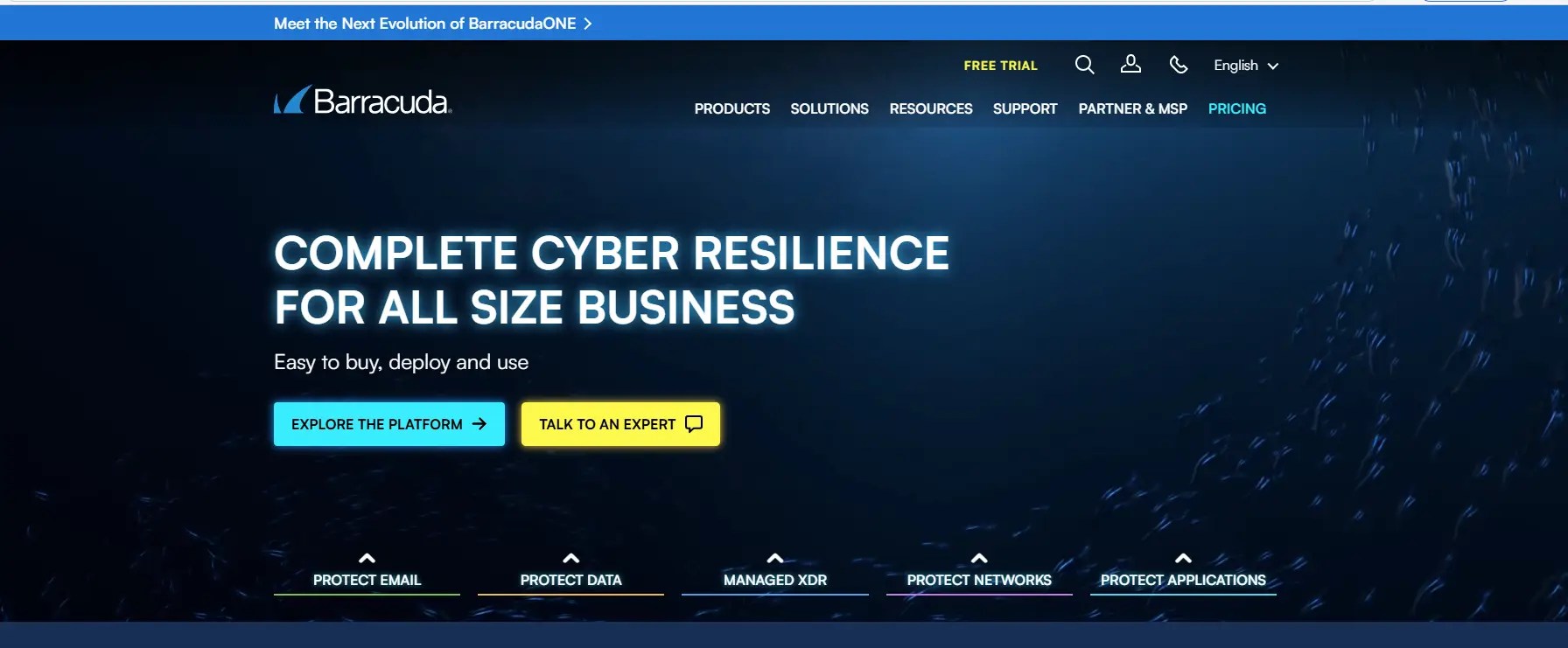
SecureEdge Homepage
The SecureEdge homepage screenshot serves as the unified entry point for cyber resilience. The headline emphasizes “Complete Cyber Resilience for All Size Business”, reinforcing BarracudaONE’s accessibility.
Key features highlighted include:
- Easy to buy, deploy, and use.
- Protection for email, data, networks, and applications.
- Managed XDR included for extended detection and response.
This homepage reflects BarracudaONE’s philosophy: cybersecurity should be comprehensive yet simple, enabling businesses of all sizes to achieve resilience without complexity.
Support & Training
The Support menu screenshot showcases Barracuda’s commitment to customer success.
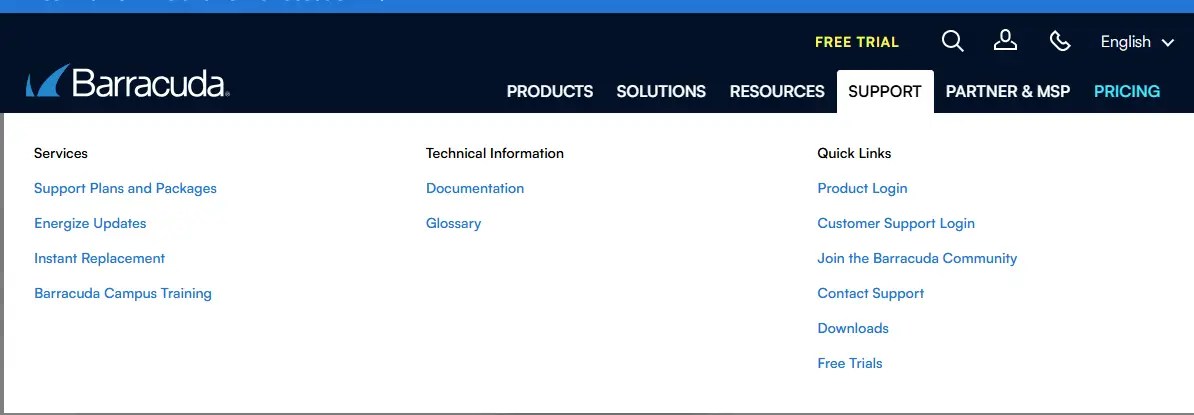
- Barracuda Campus Training provides structured learning for IT teams.
- Support Plans and Packages ensure organizations receive tailored assistance.
- Instant Replacement minimizes downtime by quickly replacing faulty hardware.
- Community and Free Trials allow customers to engage, learn, and test solutions before full deployment.
This support ecosystem ensures that BarracudaONE is not just a product, but a partnership. Organizations gain access to resources, documentation, and expert guidance, strengthening their long‑term resilience.
7. Comparison Table: BarracudaONE vs Traditional Security
| Feature | Traditional Stack | BarracudaONE |
|---|---|---|
| Email Security | Basic spam filters | AI‑driven phishing defense |
| Endpoint | Isolated antivirus | SOC‑Managed + SentinelOne EDR |
| AI Oversight | No visibility | AI Security dashboards |
| Integration | Fragmented | Microsoft 365, AWS, Google, Okta ecosystem |
| Risk Management | Manual triage | Automated blocking & triage |
Conclusion
AI is reshaping cybersecurity — both as a powerful tool and a dangerous threat. Traditional stacks are breaking under the weight of shadow AI, fragmented defenses, and compliance challenges.
BarracudaONE offers a complete, intelligent, open, and resilient platform that restores visibility, integrates defenses, and automates risk management. With its layered architecture, ecosystem integrations, and robust support, BarracudaONE empowers businesses to stay safe in the AI era.
Call to Action: Explore BarracudaONE, talk to an expert, and secure your AI future with confidence.
One thought on “AI Security Risks: BarracudaONE Cyber Resilience”